
- News
- City News
- bengaluru News
- A teacher in spotlight
Trending
This story is from January 31, 2018
A teacher in spotlight
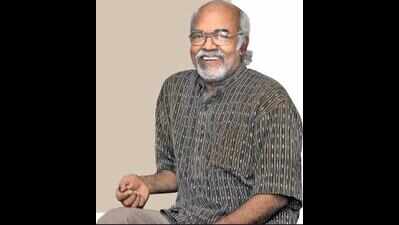
As we settle down for the interview, in the presence of his Italian mathematician wife Evelena, Nambiar displays an A4-sized timeline chart which has all his milestones since the 1950s condensed into neat lines.

He may not be a mathematician but Nambiar is one of the most significant contemporary sculptors and artists in the country, and a versatile one, at that. He has worked with clay, fibreglass, reinforced concrete, mild steel, wood, bronze and stainless steel. Jewellery enamel painting caught his fancy in the mideighties when he learned the technique for six years from Eva’s father, the late artist Paolo De Poli, who is considered the greatest enamel artist of the last century.
Nambiar has received several awards, from the National Award of the Lalit Kala Academy (1981), Karnataka State Lalit Kala Academy Award (1980) to Kerala’s highest state award, the Raja Ravi Varma Puraskaram (2015).
The first in his family to become an artist, Nambiar’s first show of paintings was held in Thiruvananthapuram in 1966 before he even began formal training in art. Born to a family with agrarian roots in Kannapuram, Kerala, Nambiar remembers ‘ploughing the land’ during his growing up years. After high school, he appeared for the Madras government drawing examination and got a job as a draughtsman in the Indian Railways. Nambiar moved to Chennai but continued to paint. Fellow artist Akkitham Narayanan introduced him to KCS Paniker, the principal of the Madras Art School, who in turn persuaded him to give up his Railways job and pursue art. He joined the college at the age of 30. “I strongly believe in formal training,” Nambiar asserts, “no matter how talented an artist you are.” But, he stresses, the statement is true only if art is taught by an efficient teacher. He believes that the current crop of talented contemporary artists in the city is only because they got training elsewhere, be it in Baroda or Shantiniketan. “Chitrakala Parishath is unable to produce such talent because of the lack of good faculty,” he says.
‘MY STUDENTS ARE MY ASSETS’
This gets him talking about his own role as a teacher. Ever since he moved to the city in 1971 – “painter Roomale Chennabasaviah and I were the only two freelance artists then” – Nambiar began the famous Bangalore Art Club, where he ran evening classes for adults and children at the Max Mueller Bhavan. In an almost unbroken tradition, he has been conducting free classes once a week (now at the NGMA) for anyone and everyone who wants to learn art. Even when he was appointed as the Chairman of the Lalit Kala Academy in New Delhi, Nambiar would visit Bengaluru on the weekends for the classes. Over the years, thousands of children have attended his classes, 50 of whom have gone on to fine art colleges and 18 have got admission in the National Institute of Design. And so, quite rightly, the retrospective will have his students and ex-students from the past 46 years lighting wicks to inaugurate the show.
One prominent ‘student-artist’ who will be attending the show is N Pushpamala. She recalls attending the art classes during her BA second year at Mount Carmel College in 1975. Nambiar spotted her talent and urged her to go to MSU Baroda for her training. “I had wanted to drop out of BA but Balan urged me to finish my degree first,” she says. Later, he met her father and persuaded him to send her to Baroda. “I did so much of work in his art classes, so many life studies, nature studies...As a teacher, he was never an authoritarian figure. We could joke with him. Back then, he would organise so many activities around art at a big hall in St Marks Road. There was an intellectual component as well.” Nambiar recalls his father-in-law often quoting Da Vinci. “He would frequently quote Da Vinci and say, ‘a good teacher is one who takes pride in the achievement of their students’. I believe that my students are my assets.
A DILIGENT TALENT SCOUT
Another role that he takes seriously is being a jury member of the Young Talent Programme conducted in association with Alliance Francaise that supports local artists below the age of 30. He scours city shows to look out for talented artists. “Show me a painting and I will even tell you the age and the social background of the artist,” he says. Ideally, he likes to visit the artist’s studio in order to look at their unfinished works and gauge their standard. “A talented artist should be good in medium handling, must produce works that can communicate, be non-redundant, and preferably, have an element of mystery or fantasy. But the hardest and most important criterion is that their works must resonate with the viewer,” he says.
This enthusiasm for talent search is not dampened by news reports like a recent one that critiqued that Lalit Kala Academy’s national exhibition held this year was probably the worst one conducted so far. “The institution had a fantastic reputation till 1984 and then started to deteriorate”, Nambiar notes. “Almost all the central and state-run cultural institutions and museums are run by untrained officials,” he laments. This is the reason why he is not associated with any institution. Also, contrary to what artists wish, he chooses not to be represented by any gallery.
“If someone wants to see my works, they can come to my studio and see it,” he says.
DOCUMENTER OF RITUAL ART FORMS
There is another line in his timeline chart, which shows his research works on the 27 different ritual arts of Kerala and Tulunadu. As art historian and editor Sadanand Menon notes, “His ample body of work includes the music and the maskmaking crafts associated with dance forms like the Bhadrakali Teyyams and Titambu Nrittams of north Kerala and the Bhutas of south Karnataka, to the body and floor decoration rituals like Nagamandala and Paambinkalam. Balan’s curiosity to understand people’s’ aesthetics and his propensity to get seduced by any constructed form has resulted in a substantial body of published papers and a unique archive of several thousand rare pictures and rarer pieces of musical recordings.”
Sculpting In Time – Balan Nambiar and his Six Decades of Engagement with Materiality will be on show from February 4 to Mar 3 at NGMA.
End of Article
FOLLOW US ON SOCIAL MEDIA





Hot Picks
TOP TRENDING
Trending Stories
In City
Entire Website
- Breathtaking cosmic catwalk! SpaceX makes history with first-ever private spacewalk
- 2 Army officers thrashed, their female friend gang-raped in Madhya Pradesh
- Bangladesh announce Test squad for India tour
- Top fastest trains in the world: From China's CR Harmony to Germany's ICE
- Amid Shannon Sharpe Viral Video, Former ESPN Host Michelle Beadle Reacts Claiming It Was Not Her
- Ayushman Bharat insurance scheme expanded to cover elderly above 70
- 'Will be demolished if... ': Himachal minister's assurance amid Shimla mosque row
- Mumbai's Haji Ali and Mahim dargahs cancel Eid shamiana
- Garena Free Fire MAX redeem codes for September 11, 2024: Win free room cards, skins, diamonds, pet skins, and more rewards today
- GK for students: Top 8 Largest Mammals in the World
- In the (y)ear of conspiracy theories, Trump hears insults galore
- Adani Group rejects Hindenburg claim of $310 mn asset freeze in Swiss banks
- Why you should not be fooled by ‘20-year SIP crorepati’ dream
- On Mamata's 'ready to resign' offer, protesting docs say 'want justice'
- IAF wants Tejas jet production to be ramped up as US delays engines supply
- Haryana polls: Rebellion erupts after Congress leaders file independent nominations
- Your cousin’s poo can now cure your chronic stomach problems
- Planning to buy iPhone 16? How much Apple will give for iPhone 12 & others
- Pandya triggers speculation over his Test comeback
- 'Given many reasons ... ': Former FBI official says Trump could be Russian 'asset'

Popular Categories
Hot on the Web
Top Trends
Trending Topics
Alia BhattMalaika Arora Father DeathArbaaz KhanNatasa StankovicMr Bachchan OTT ReleaseNational Parks In IndiaSelena GomezGOAT CollectionVikas Sethi DeathMalayalam ProducersIndia's Best Dancer 4Simi GarewalDilli BabuIndian National ParksLaung BenefitsVikas SethiiPhone 16Microsoft 365 OutageCsir Ugc Net 2024Wordle Answer
Living and entertainment
Latest News
Epilepsy medication shows promise of treating sleep apnoea symptoms: StudyIndia successfully flight tests surface-to-air missileDigest this: Unhealthy gut may be linked to Parkinson’s diseaseCSIR UGC NET 2024 result declared: Steps to download scorecards at csirnet.nta.ac.in'Played a big role in turning the cricket around': Ricky Ponting applauds Virat Kohli’s brilliance as India’s former captainAadhaar card update: Do you have to compulsorily update details on your Aadhaar every 10 years?Single Indians are now choosing slow, meaningful dates over-elaborate outings, reveals an online dating platform’s surveyExclusive- Saurabh Gumber reveals joining a new show during Ganeshotsav says, "I consider it as Bappa's small gift and believe he has great plans for me ahead"Who was Illia 'Golem' Yefimchyk, the Belarusian bodybuilder who consumed 2.5 kg of meat and 108 sushi pieces daily before his death at 36?Pakistan: Bilawal cautions Shehbaz govt against political victimisation, points to Imran Khan's caseVijay Varma reveals he was DROPPED from 'Sacred Games' at the last minuteMahindra Thar Roxx with VIN 0001 to be auctiond for charity: How to registerWWE Star Discusses Why Sid Vicious Deserves a Hall of Fame SpotVijay Sathya-starrer 'Dhil Raja' to release in SeptemberHarvard University Sees Drop in Black Freshman Enrollment Post-Supreme Court Ruling on Affirmative ActionSalman Khan surrounded by bodyguards as he arrives at Malaika Arora's mother's house to offer his condolences - WATCHCMF Buds Pro 2 by Nothing review: Big delivery on a budgetMallika Sherawat makes big screen comeback in Rajkummar Rao's 'Vicky Vidya Ka Woh Wala Video'; director reveals why he cast her
Copyright © 2024 Bennett, Coleman & Co. Ltd. All rights reserved. For reprint rights: Times Syndication Service